
How Investors Are Using AI to Trade in 2025
Last year, the market size for artificial intelligence tripled (per Statista). New LLMs gained popularity, thousands of AI-powered tools launched, and generative AI began to appear in search engines. During this time, AI also began to reshape the stock market, with a surge in new tools that simpl...
- #Stocks Guide
Last year, the market size for artificial intelligence tripled (per Statista). New LLMs gained popularity, thousands of AI-powered tools launched, and generative AI began to appear in search engines. During this time, AI also began to reshape the stock market, with a surge in new tools that simplify decision-making and level the playing field for individual investors.
Still, many are wondering exactly how successful investors are getting the best value out of AI.
In this article, we’ll explore some of the top use cases for AI in the stock market, and look further into trends that might impact trading in 2025.
Key Takeaways In 2025, many investors are leveraging AI for:
- Real-time data analysis: AI processes massive amounts of financial data quickly, uncovering actionable insights.
- Predictive analytics: Machine learning models help traders forecast price movements and optimize strategies.
- Market sentiment analysis: AI tracks public sentiment across news and social media, providing a competitive edge.
- Democratization of trading: AI tools are more accessible than ever, offering advanced features at affordable prices.
Decoding Complex Market Data
Traders oftentimes face an overwhelming volume of financial information, from earnings reports, to breaking articles and social media trends. AI can simplify this challenge by eliminating all of the noise, and analyzing these datasets for valuable insights in real-time.
For instance, some AI-powered stock platforms like Zentrix.ai can scan news headlines, financial reports, and online chatter to gauge sentiment about a stock. This ability to process and interpret vast amounts of data allows traders to identify opportunities that would otherwise be missed. A process that once would’ve taken hours to manually do, can now be done in seconds.
“AI has become my go-to tool for spotting trends,” says Sarah Miller, a trader with five years of experience. “It cuts through the noise and shows me where to focus my attention. I’ve seen my trade success rates increase, without having to spend more time researching or stressing about the latest developments.”
Forecasting Market Movements
AI has also started to impact the quantitative side of investing. Fields like predictive analytics combine historical data with real-time inputs to flag high-probability trading opportunities. With machine learning and AI, this data analysis and forecasting can be done almost instantly, and with fewer errors. While human decision-making might lag during volatile market conditions, AI can adapt and alert traders to shifts in real time. This speed is particularly critical for day traders who thrive on minute-to-minute market fluctuations.
Traders are leveraging predictive analytics to identify breakout stocks, calculate entry points, and monitor technical indicators like RSI or Bollinger Bands. Insights from this automated approach are often used as a starting point for the decision-making process, and are not the sole source of information behind a trade.
Simplifying Advanced Strategies
In the past, strategies like algorithmic trading required technical expertise and expensive resources. Most individual traders could only dream of such tools, while major institutions invested millions into them. Today, AI tools make these strategies accessible through intuitive interfaces and prebuilt templates.
The days of making manual trades that rely solely on analyst ratings or the latest news articles are over. Traders are now using AI trading platforms for automated trade execution, backtesting strategies, and custom-tailored trading setups.
“I’ve managed to create a nearly hands-free trading strategy,” said Mike Richards, a swing trader with three years of experience. “With custom triggers and automated execution, I could technically be making a trade as we speak.”
Zentrix MCP
Want this wired into your own AI agent?
Zentrix MCP connects Claude, GPT, and Gemini to live market data and analysis, no copy-pasting numbers into a chat window.
Join the waitlistTracking Market Sentiment
Public sentiment is a powerful force in financial markets, often driving short-term price fluctuations. AI-powered sentiment analysis tools help traders track how investors feel about specific stocks or sectors by scanning news articles, social media posts, and financial blogs.
Benefits of Sentiment Analysis:
- Detect shifts in market mood before they’re reflected in prices.
- Avoid stocks with negative sentiment that could underperform.
- Act quickly on bullish trends highlighted by positive sentiment.
For instance, an AI tool might flag a surge in optimism around a company after a major product launch, giving traders a chance to capitalize on the momentum. On the other side, it could help traders avoid losses by flagging recent declines in sentiment online.
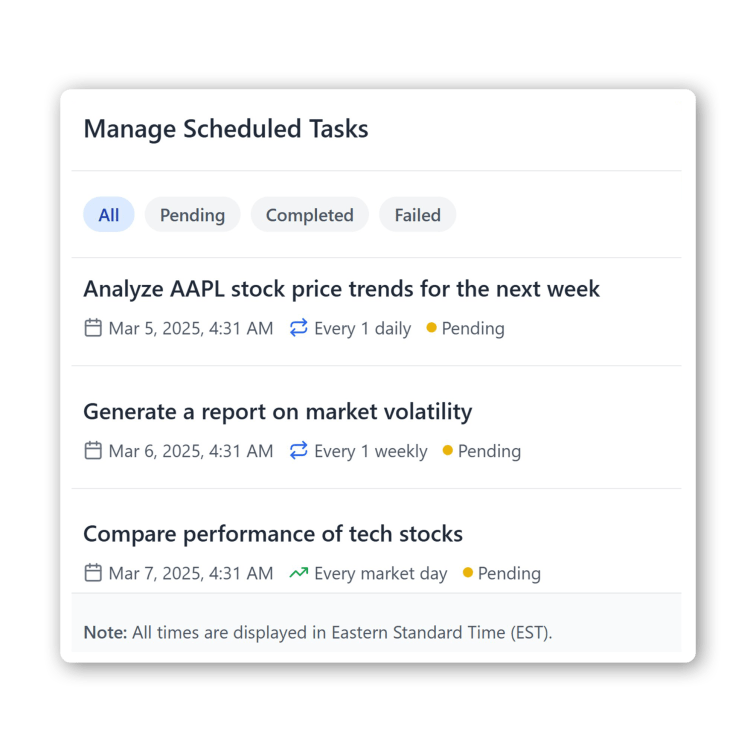
Zentrix’s ‘Agent Scheduler’ interface, which allows users to set up recurring stock market analysis tasks
Furthermore, AI sentiment analysis isn’t limited to text. Some tools now incorporate audio and video recognition, analyzing investor sentiment from earnings calls or financial YouTube videos. These innovations provide traders with an even more comprehensive understanding of market dynamics.
Making AI Tools Accessible
Perhaps the most significant shift in 2025 is how accessible AI-powered trading tools have become. Affordable subscription models and easy-to-use platforms mean that traders at all levels can harness advanced technologies. Many platforms also now offer free trials or limited-feature versions, allowing traders to test their capabilities without making a financial commitment. These options lower barriers to entry and encourage more widespread adoption.
Key Features to Look For in an AI Trading Tool
- Real-time market alerts: actionable insights that you can trade off of.
- Sentiment, technical, and fundamental analysis: quantitative and qualitative data to inform your trades.
- **Affordability: **AI tools are becoming increasingly affordable, especially as competition increases.
AI tools are no longer exclusive to institutional investors. Retail traders now have access to resources that were once out of reach, helping them compete in increasingly complex markets.
Looking Forward
As AI continues to evolve, its role in trading is expected to grow even further. Emerging trends such as automated portfolio management, deeper integration with blockchain technology, and enhanced predictive capabilities through quantum computing are set to reshape how investors approach the markets.
In addition to these advancements, AI is expected to incorporate even more alternative data sources, such as satellite imagery, geolocation insights, and ESG (environmental, social, governance) metrics. These new dimensions could provide traders with unprecedented insights into market conditions.
Traders who stay ahead by adopting these advancements will be well-positioned to thrive in the ever-changing financial landscape.
As the technology progresses, AI could also become more transparent, explaining the rationale behind its recommendations. This would give traders greater confidence in AI-generated insights, further bridging the gap between human intuition and machine precision.