
How to Trade Stocks While Working Full-Time
How to Trade Stocks While Working Full-Time Balancing a full-time job with any serious trading strategy can feel impossible. Markets move quickly, news breaks in seconds, and by the time you're on lunch break, your favorite stock may have already spiked or crashed. Yet many successful retail trad...
- #AI
Balancing a full-time job with any serious trading strategy can feel impossible. Markets move quickly, news breaks in seconds, and by the time you’re on lunch break, your favorite stock may have already spiked or crashed.
Yet many successful retail traders do manage both. They build consistent routines, use smart automation, and increasingly rely on AI-powered tools to handle research, scanning, and alerts during the workday.
In this guide, we’ll walk through how to trade stocks while working full-time. You’ll learn how to stay informed, reduce your screen time, automate research tasks, and improve decision-making even if you can’t monitor markets all day.
Why Full-Time Workers Struggle With Trading
Before jumping into strategies, it’s important to understand the core challenge: time.
If you work 9 to 5 (or any structured shift), your job demands your attention. Markets, however, reward constant monitoring. That creates tension in several ways.
Markets Move During Work Hours
U.S. stock market hours (9:30 AM to 4:00 PM ET) overlap almost perfectly with the traditional workday. Most major moves, volume spikes, and economic releases occur between these hours.
Research Takes Time
Successful trading requires reviewing price history, technical indicators, fundamental news, market sentiment, earnings calendars, and macroeconomic data. This is a lot to digest, especially before your morning commute.
Information Overload
One of the biggest problems traders face is the sheer volume of data and rapid pace of market changes. A full-time worker simply doesn’t have the bandwidth to manually parse everything.
Emotional Decision-Making
Checking your trades sporadically on your phone often leads to impulsive decisions, usually bad ones.
The Good News? Full-Time Workers Can Trade Successfully
You don’t need to stare at charts all day. In fact, some of the most consistent retail traders use highly structured routines that minimize screen time.
The key is building systems (automated, disciplined, and repeatable systems) that operate even when you’re not watching the market.
Let’s break down the practical methods.
1. Choose a Trading Style That Matches Your Schedule
Not all trading styles are compatible with a full-time job. Scalping? No way. High-frequency day trading? Impossible. But several styles do work well.
Swing Trading (1 to 10 Days Holding Period)
Swing trading is arguably the best match for full-time workers. It focuses on larger, multi-day price movements rather than minute-by-minute volatility.
Why it works: You only need to check charts once or twice per day.
Best for workers who prefer structured routines, want to avoid intraday noise, and can review markets before and after work.
Position Trading (Weeks to Months)
Position traders build long-term theses and rely heavily on fundamentals and sentiment trends.
Why it works: The time horizon is slow, and decision points are infrequent.
Best for workers who want even less screen time and follow economic cycles or earnings.
Algorithmic or Automated Trading
Automation is becoming increasingly accessible. Many brokers allow conditional orders such as stop-loss, trailing stop, OCO (one-cancels-the-other), and limit buys/sells. Some platforms even offer automated strategy execution.
Why it works: Your strategy runs even while you’re in back-to-back meetings.
2. Build a Pre-Market and Post-Market Routine
Even if you’re busy from 9 to 5, there are two windows you can control: pre-market (before work) and after-hours (after work).
Successful full-time traders structure their workflow around these windows.
Morning Routine (30 to 45 minutes)
Review your open positions. Look at overnight news, after-hours price action, and market futures.
Scan for stocks with catalysts like earnings, guidance changes, analyst upgrades/downgrades, or economic releases.
Check market sentiment. Studies show that market news sentiment strongly correlates with short-term price action.
Identify potential trade setups using watchlists, scanners, or AI tools to narrow down opportunities.
Set conditional orders. This allows you to automate entries and exits during the day.
After-Work Routine (20 to 30 minutes)
Review what happened during the trading day. Look at chart setups, volume spikes, and any economic news.
Update your watchlist by removing dead tickers and adding promising ones.
Prepare for the next day. You won’t have time to do this during work, so preparation is essential.
3. Use Automation to Cover the Hours You’re Busy
This is where modern tools (especially AI agents) are game-changing.
You cannot watch the market all day. But an automated system can.
AI-driven platforms can handle repetitive tasks while you’re away from the screen, like scanning the market, monitoring sentiment, generating technical analysis reports, and alerting you when price thresholds are hit.
Automation doesn’t “trade for you” unless you explicitly enable it, but it does ensure you get the right information at the right time.
Zentrix MCP
Want this wired into your own AI agent?
Zentrix MCP connects Claude, GPT, and Gemini to live market data and analysis, no copy-pasting numbers into a chat window.
Join the waitlist4. How AI Agents Can Do Your Daytime Research
AI is now one of the biggest equalizers for full-time traders.
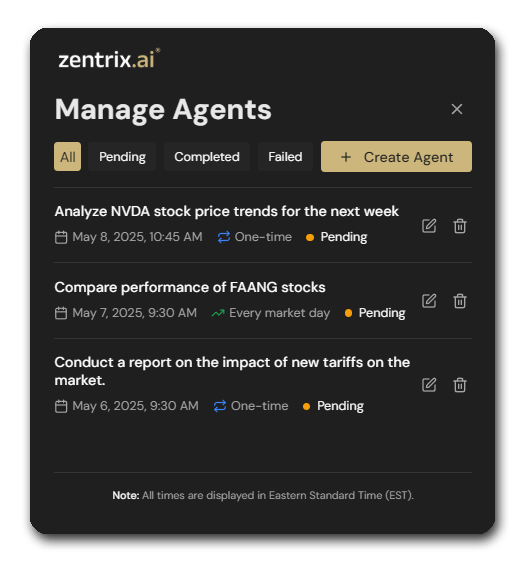
Tools like Coach Z (an AI stock analyst) can be scheduled to run tasks throughout the day and send you actionable insights while you’re in meetings, commuting, or focused on work.
Real-Time Data Fetching
AI agents analyze chart data, technical indicators (like RSI, MACD, and moving averages), volume patterns, and volatility, just like a human analyst.
Sentiment and News Analysis
AI scans web articles, forums, and news sources to gauge sentiment. This saves traders hours each week.
Scheduled Recurring Tasks
This is the most powerful feature for full-time traders. You can schedule AI tools to perform routine checks such as:
- Morning Market Movers Scan (Daily at 7 AM): Run before the market opens to find potential breakout stocks based on pre-market volume, news sentiment, technical setup patterns, and overnight catalysts. You get the full report before you start your workday.
- Portfolio Review (Daily at Noon): If you’re holding positions, AI can evaluate technical strength, summarize breaking news, notify you of unusual volume, and issue sentiment updates. Perfect for staying informed without breaking focus during work.
- End-of-Day Recap: After the market closes, AI can analyze what moved your watchlist stocks, whether setups strengthened or weakened, and which tickers deserve attention for the next day.
This structure turns your trading into a fully managed research pipeline.
5. Leverage Watchlists, Alerts, and Smart Notifications
Full-time traders manage risk by automating as many notifications as possible.
Use Price Alerts
Services like TradingView and Thinkorswim allow custom alerts for breakout levels, moving average crosses, RSI thresholds, and volume surges.
Use Broker-Based Conditional Orders
These include limit orders, stop orders, trailing stops, OCO orders, and bracket orders. Conditional orders prevent you from having to manually enter trades while working.
6. Limit Your Watchlist to 10 to 20 Stocks
If you’re juggling a full-time job, you cannot follow 50+ stocks effectively. Professional traders specialize, and you should too.
A good watchlist structure includes core stocks (5 to 10 stocks you know well and trade repeatedly), a momentum watchlist (5 stocks showing strong volume or news-driven movement), and long-term holds (5 positions you rarely transact but still monitor).
7. Follow Macro News Efficiently
Instead of reading dozens of articles, follow summarized, high-level macro updates like Federal Reserve announcements, CPI, PPI, employment reports, and earnings season summaries.
Reliable sources include CNBC Markets, Bloomberg, The Wall Street Journal, and the U.S. Bureau of Labor Statistics.
AI sentiment systems can automatically detect relevant news and summarize it for you.
8. Use Paper Trading to Refine Your Strategy
If you’re new or testing a strategy, start with paper trading.
Paper trading helps full-time workers test whether your routines are realistic, whether your alerts work, whether your automation is reliable, and whether your risk management holds up. This prevents costly mistakes during the learning curve.
9. Keep a Trading Journal (Don’t Skip This)
Your career or daily job already requires feedback loops. Trading should be the same.
Track entry and exit reasons, emotions, win rate, risk allocation, news sentiment, and technical signals. AI tools can help summarize your trades or automate journaling, but the reflection process is invaluable.
10. Protect Yourself From Overtrading
Full-time workers tend to overtrade because they feel they need to “catch up” after missing the day’s action.
Avoid impulsive trades during breaks, chasing midday volatility, revenge trading, and overreacting to notifications. Structure prevents chaos, so lean on routines, not emotion.
You Don’t Need to Quit Your Job to Trade Successfully
Full-time workers can trade effectively, but only with structure and automation. Without a plan, the market will overwhelm you. With a system, you can thrive.
Here’s the formula:
- Pick a trading style that matches your schedule. Swing trading and position trading are ideal.
- Build daily routines. Pre-market and post-market reviews are essential.
- Automate research. Use AI agents to monitor setups while you work.
- Use alerts and watchlists. Reduce your screen time and increase focus.
- Make decisions outside of work hours. Plan your trades and don’t react emotionally.
The tools exist to help you succeed without sacrificing your career. It’s about working smarter, not harder.